Article ·
Interest Rates, Stock Market Participation, and Households
This week I replicated the model built by Juan M. Morelli (research economist at the NY Fed) to see how interest rate hikes affect households that participate in the equity market — and how that connects to the real economy.
In the mid-1980s, less than 30% of retail investors held equity. By the 2000s, more than 50% of households were invested in the stock market, through mutual funds or direct equity.
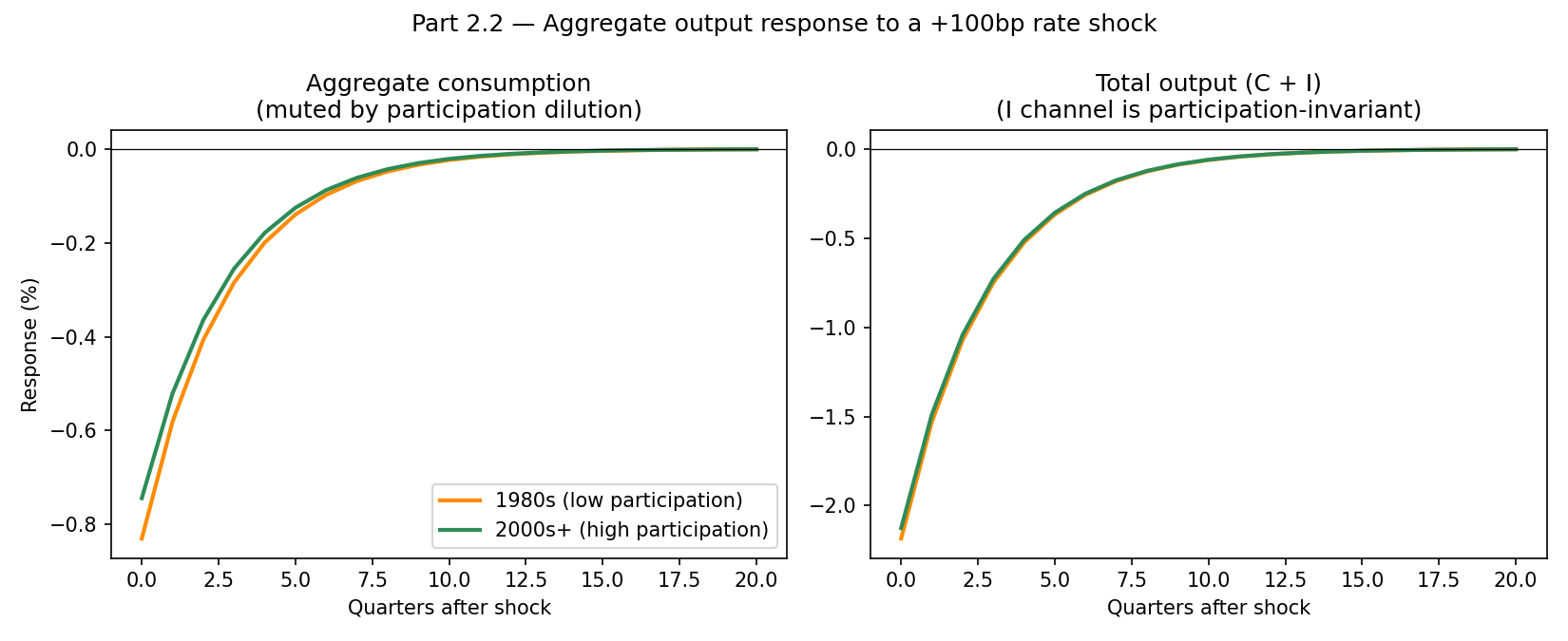
This shift in market participation has changed how output responds to interest rate changes: stock market fluctuations are now spread across a much larger share of households, which moderates the swings in consumer spending.
The mechanism
To answer the underlying question — why does this new participation matter? — consider a simple setup before turning to the data. There are two groups: participants and non-participants.
- Participants trade bonds and equity.
- Non-participants trade only bonds.
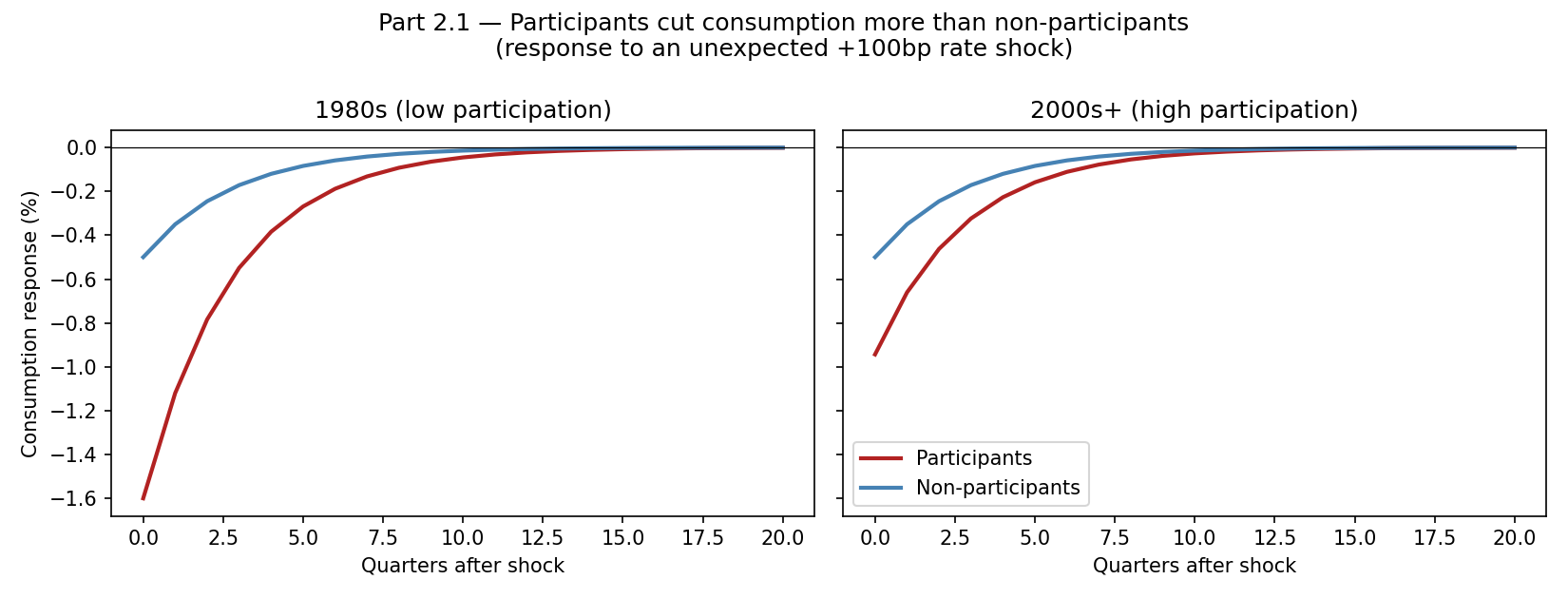
- Participants finance their equity holdings with debt, which exposes them to procyclical assets. Because of this, they bear more risk than non-participants and are more sensitive to interest rate changes.
When interest rates rise: stock prices fall → debt costs increase → consumption falls.
But as participation increases, that shock to the aggregate equity market gets spread across a larger pool of households. Each participant now holds a smaller equity position and carries less leverage, so the effect of stock price moves and financing pressure from higher rates is weaker. In short: adding more participants — the group most sensitive to rates — produces a smaller aggregate consumption response.
In the real economy, when stock prices fall, the market value of installed capital declines relative to the cost of building new capital, making investment projects less attractive. So smaller moves in stock prices translate into smaller adjustments in investment spending.
With this mechanism in mind, we can turn to the model and match the empirical response of equity prices and investment spending to an unexpected interest rate change.
Participants cut consumption more than non-participants
Aggregate output response
Source: Juan M. Morelli (2021), “Limited Participation in Equity Markets and Business Cycles,” Federal Reserve Board, Finance and Economics Discussion Series 2021-026.