Article ·
Valuing Rosneft with a DCF: Oil, Sanctions and the Vostok Oil Project
How do you value one of Russia’s largest companies when it operates in a market driven by oil prices, sanctions and geopolitical uncertainty?
I recently finished my DCF of Rosneft (ROSN) and, honestly, the process turned out to be far more interesting than the final result.
Those of you already familiar with valuation are probably wondering why I didn’t simply use a relative valuation, comparing multiples with other companies in the sector. The truth is that it would have been a much faster and more efficient approach.
However, I chose a DCF because I wanted to isolate, as far as possible, the risk and market sentiment that weigh on investors when taking positions on the MOEX. An intrinsic valuation lets us analyse how, and how much, the oil price affects Rosneft, what its growth prospects are, and which new projects could benefit the company in the future.
Had I based the analysis solely on multiples, I would have been indirectly baking in the market sentiment and the negative momentum the company has carried in recent years, driven, among other factors, by growing tensions with the West and restricted access to the international financial system.
But before getting to the result, let me walk you through the process and the questions that came up as I dug deeper into its financial statements.
1. Gathering the information
The first step, as in any DCF, was to find and gather as much information as possible.
The main source was, naturally, Rosneft’s Investor Relations section (rosneft.com). I also used other sources, such as Russtock.ru, to complement the information available on the company.
The first difficulty appeared quickly: how do you value a company when the available financial information is far more limited than for a Western company?
Since 2022, the Russian government has introduced measures allowing certain companies and financial institutions to restrict the disclosure of financial information. In 2023, a presidential decree extended these measures to certain companies deemed strategic, allowing them, under specific circumstances, not to publish their IFRS financial statements.
Even so, Rosneft still publishes some basic financial and operating metrics, which makes it possible to build a valuation, albeit with limitations and with the need to cross-check the information against different sources.
2. Projections
Once the financial statements were gathered, the second step is to project them five years ahead (2026–2030). This is genuinely the most interesting part, because Rosneft’s profitability and growth depend above all on two factors: production volume and the oil price.
Production: the Vostok Oil project
To project revenue, for example, I couldn’t simply assume linear growth based on history. Why? Basically, because Rosneft has launched its oil megaproject in the Krasnoyarsk region, in the Arctic. As I have discussed in other articles, the fossil fuel sector periodically requires large CAPEX investments to develop new fields and sustain production.
In Russia’s case, the centre of gravity of production has kept shifting: from Baku in the south in the 1930s and 40s, through the Siberian fields, to today’s Arctic fields.
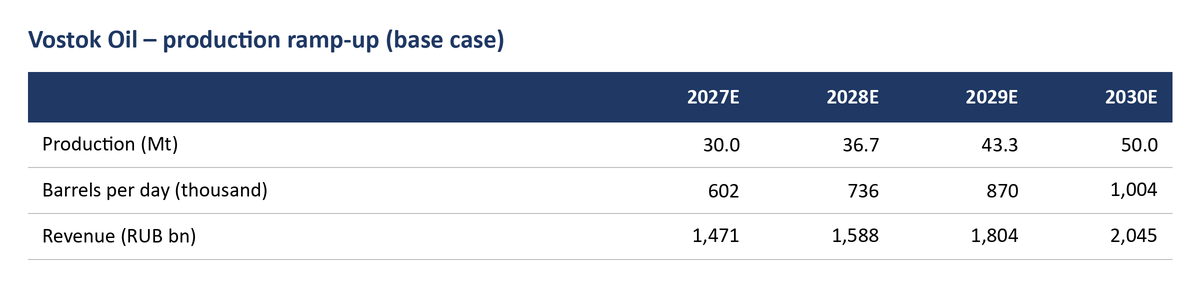
With Vostok Oil, Rosneft expects to reach a full-capacity output of between 50 and 100 million tonnes a year. For my analysis I took the conservative scenario of 50 million tonnes, with a linear ramp-up that starts at 30 million tonnes in 2027 and reaches full capacity in 2030.
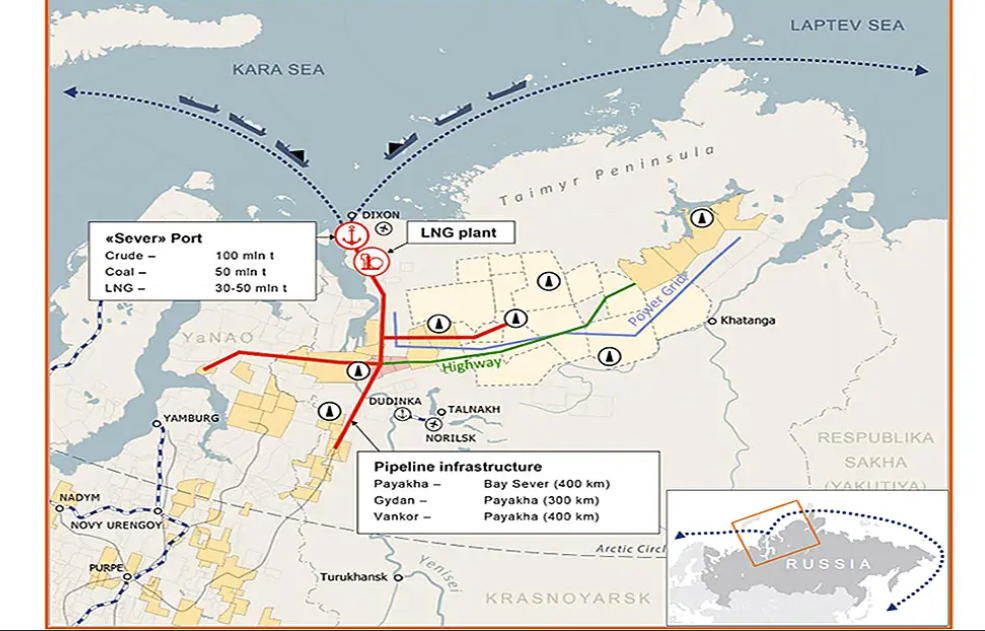
From here we can estimate revenue. We take 2026 revenue as the base (keeping production from existing fields in line with previous years) and, from 2027 onwards, add the incremental production from Vostok.
For reference, one tonne of oil is roughly 7.3 barrels. With 30 million tonnes in the first projected year, that means around 220 million barrels a year, or roughly 602,000 barrels per day.
Oil price: three scenarios
This is where the oil price comes into play. As of this writing, benchmark crudes such as Brent and WTI are trading around $100 per barrel in the futures market due to tensions with Iran.
That said, I built three scenarios for the oil price over the coming years. In all of them, prices trend towards stabilising around $60–70 per barrel by the end of the projection period.
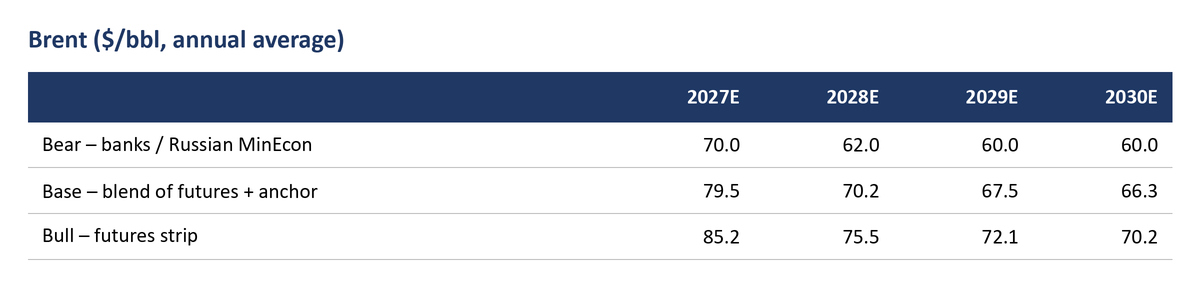
- Bear case: we simply take the forecasts from J.P. Morgan and Russia’s Ministry of Economic Development.
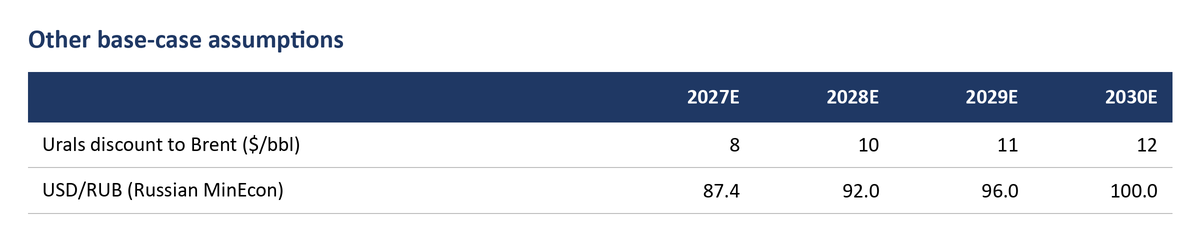
- Base case: we start from an anchor value (the EIA STEO forecast of $73.7 for 2027 and a long-run mid-cycle Brent of $65 thereafter) and blend it with the price of long-dated futures contracts (CME Group), with the weight on futures falling from 50% to 25% over time. On top of that, we apply the Urals discount to Brent.
- Bull case: simply reflects what the market is willing to pay today, taking into account all the geopolitical tension and supply chain disruptions.
Revenue
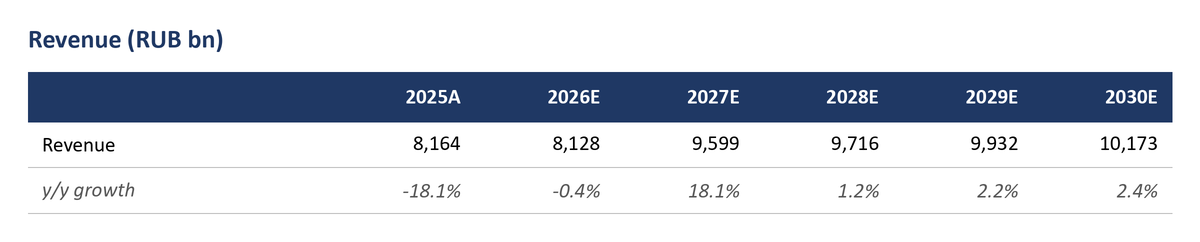
If we combine these oil price projections with the production coming from Vostok, revenue jumps by 18% in 2027, when Vostok starts producing, and then keeps growing steadily as the project matures and approaches its target capacity of 50 million tonnes a year.
Margins: EBIT and D&A
For EBIT, instead of assuming the same margin for existing production and for the new Vostok production, I give the latter a higher margin thanks to the reductions in the Mineral Extraction Tax (MET) granted by the Russian government: tax relief of roughly RUB 2.6 trillion.
In addition, to keep the identity EBIT = EBITDA − D&A, we subtract the year-over-year increase in D&A from EBITDA. As a result, the EBIT margin gradually narrows from 21.9% in 2027 to 19.3% in 2030.
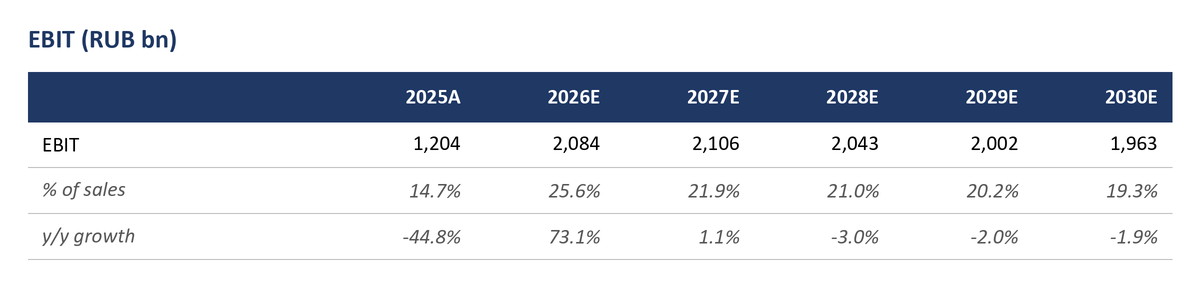
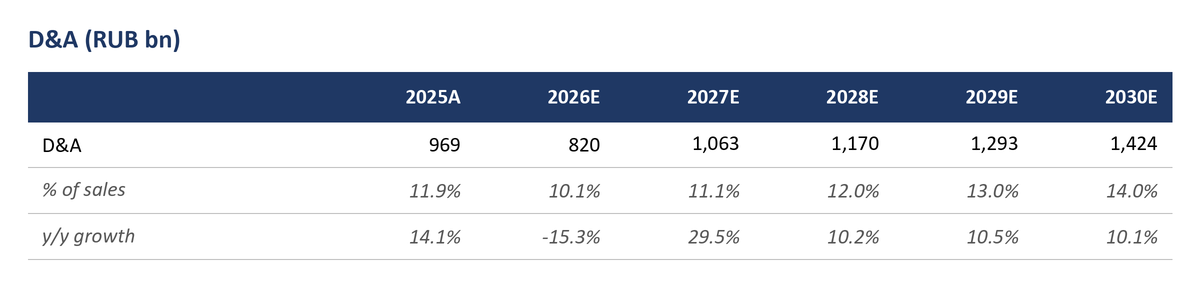
Why does D&A increase? When a project like this starts producing, all the infrastructure investment accumulated on the balance sheet as Construction Work in Progress (CWIP) is reclassified as Property, Plant & Equipment in service. From that moment it starts to be depreciated, and that depreciation hits the income statement through D&A, affecting EBIT and, via taxes, future cash flows.
CapEx
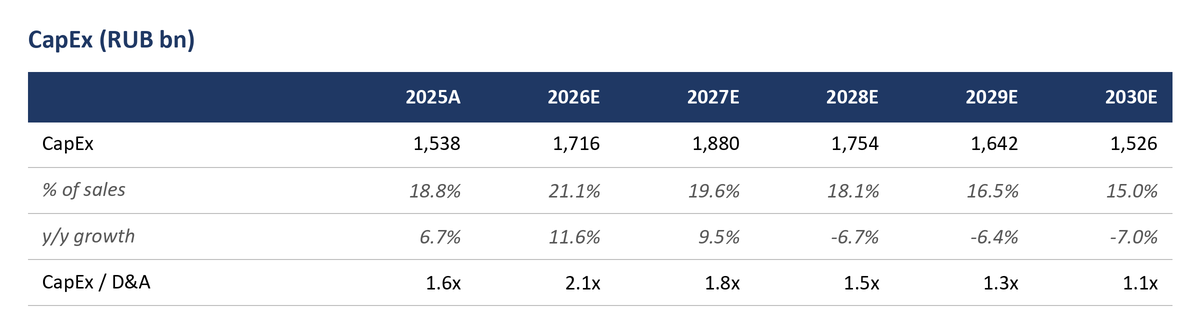
As the project matures, infrastructure investment declines just as D&A rises: CapEx peaks at RUB 1,880 bn in 2027 and falls to RUB 1,526 bn in 2030, converging towards D&A. This makes sense: if CAPEX grew indefinitely above D&A, it would mean Rosneft is constantly expanding; conversely, CAPEX systematically below D&A would indicate that assets are depreciating faster than the company invests to maintain or improve them.
3. Discount rate
Risk-free rate: the Russian monetary context
This is probably the most important point for a company operating in Russia. Russia is currently going through financial isolation, which is the single most important structural factor for the share price performance and access to funding of companies listed on the MOEX.
However, the Russian financial system has, to some extent, managed to develop domestic mechanisms and alternative channels for the circulation of capital.
As a result of this exclusion, the Russian economy has suffered a considerable loss in the value of money: CPI rose from 3–5% before 2022 to a peak of 17% in mid-2022. This forced the Central Bank of Russia to raise interest rates as high as 21%, although the situation now appears to have stabilised at around 6–7%. According to the Central Bank itself, this recent stabilisation has opened the door to talk of future monetary easing.
This matters when calculating the WACC because, with a local risk-free rate of around 16%, investors will demand a higher return to put their money into Rosneft rather than into government bonds.
Beta: which index should we measure risk against?
The next factor is estimating the stock’s implied risk relative to a reference portfolio. Here I had two options:
- A local Russian reference portfolio: however, this would not strip out the market risk, and we would not really be able to isolate Rosneft’s idiosyncratic risk.
- A global reference portfolio, such as the MSCI World: this is the approach I decided to use, in order to really separate Rosneft’s risk from Russia’s country risk. Obviously, this has made the beta very small (0.15), since the correlation is close to zero, or even negative, due to the different realities resulting from Western financial exclusion.

Country risk premium
Next, we need to add Russia’s Country Risk Premium (CRP) separately. For this, we can use the data compiled by Professor Aswath Damodaran of New York University (NYU).
The idea behind the country risk premium is to use CDS (credit default swap) spreads as a reference and multiply them by the ratio of equity market volatility to bond volatility. Damodaran uses CDS because they represent the credit risk of a default on debt, whether government or corporate bonds.
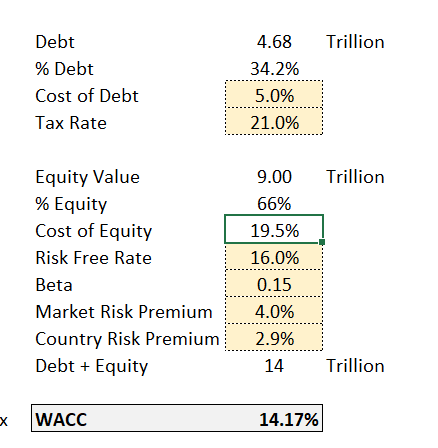
However, Russian sovereign CDS have not traded since 2022, so Damodaran uses the PRS (Political Risk Services) Country Risk Score instead. Russia scores roughly 70 points, which Damodaran equates to a 2.56% default spread, and then multiplies it by about 1.5 (equity volatility / bond volatility). That gives us the following result:


WACC
Putting it all together gives a cost of equity of 19.5%, against a risk-free rate of 16%. Weighting it with the much cheaper cost of debt (5% pre-tax, with a 21% tax rate) at a capital structure of roughly 34% debt and 66% equity, we arrive at a final discount rate (WACC) of 14.2%.
4. Valuation
Now that we have the final discount rate for Rosneft under the current situation, we can move on to calculating the present value of the future cash flows.
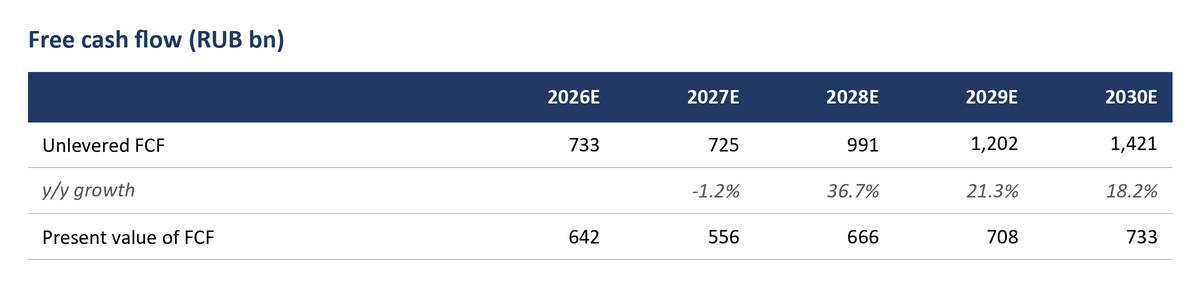
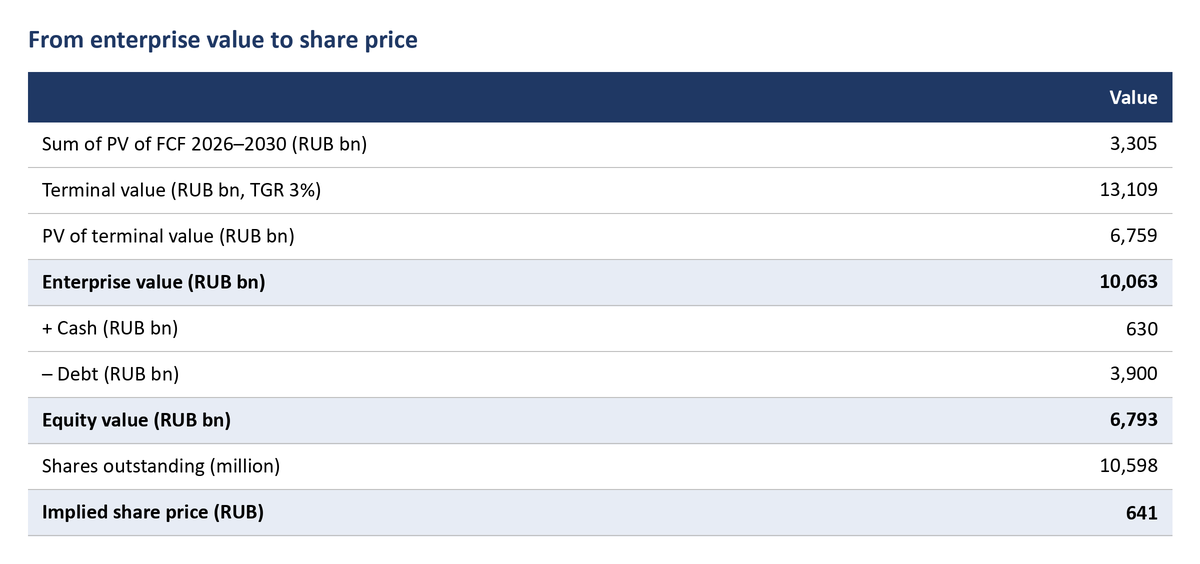
For the terminal value I assume a perpetual growth rate (TGR) of 3%. It is worth noting that the terminal value accounts for around two-thirds of the enterprise value, which is common in a capital-intensive business like this one.
Conclusion
According to the model, Rosneft shares should be trading at around RUB 641, while they currently trade at around RUB 360 per share. That represents an upside of roughly 78% (the stock trades at about 56% of its fair value) if we rely on the future production coming from the Vostok project. Obviously, the Russian market is currently very sensitive to any political or geopolitical change, on top of Rosneft’s own risks from depending on a commodity like oil, which the major powers use as a tool of geopolitical pressure.
If the oil price stays elevated, Rosneft’s earnings could skyrocket. However, this analysis assumes that the conflict with Iran and the disruptions in the Strait of Hormuz will ease, and that oil will therefore start flowing again through the strait and the various pipelines.
To access the DCF, you can visit this link. From there you can also go to GitHub to see the code used to calculate the beta and the different oil price forecasting models.
All criticism is welcome, as long as it is respectful and aimed at learning and improving my analysis. You can send your suggestions to marcaliagaborras@gmail.com.
Thank you very much!